Post-doc Researcher
Campus du Solbosch - CP 165/63
Avenue F.D. Roosevelt, 50
1050 Bruxelles
-
Biosketch
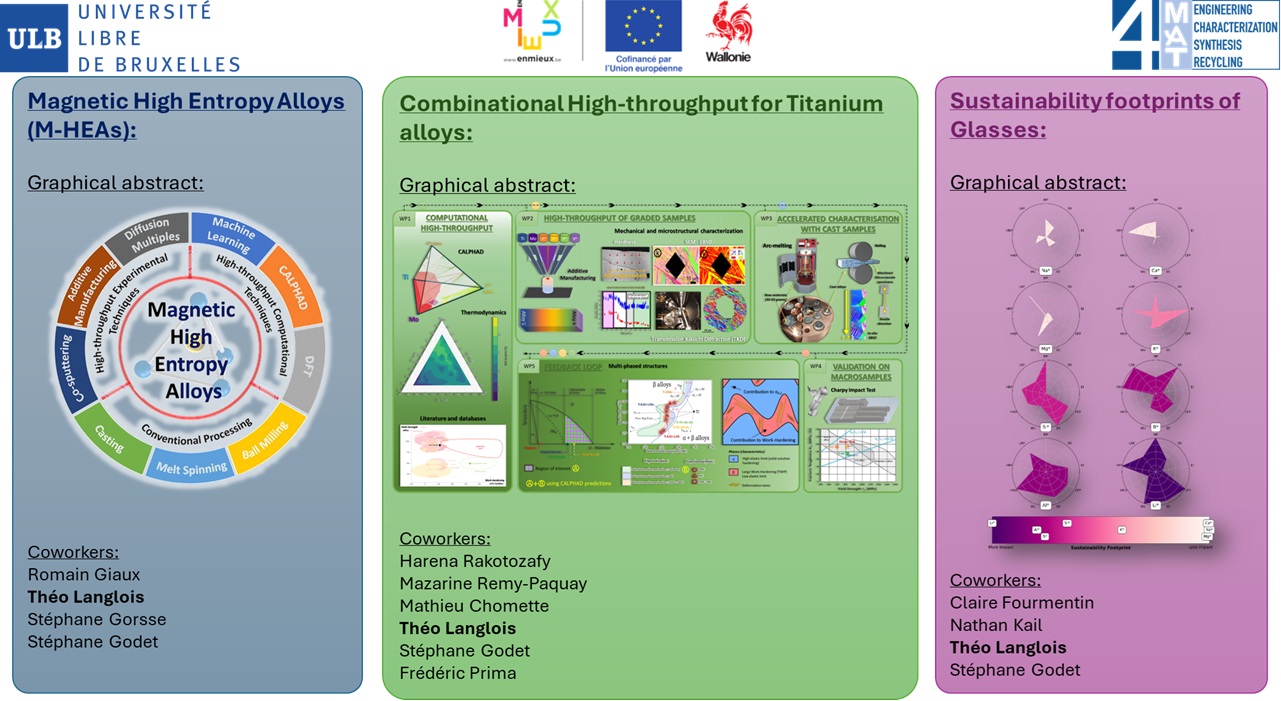
- Theo Langlois is a PostDoctoral Researcher at the Université Libre de Bruxelles and scientific staff at the 4MAT Department. He got is Master’s degree at Institut National Polytechnique de Grenoble (France) and his PhD Degree at Deakin University (Australia) / INSA Lyon (France), both with major in Materials Science. His current research topics include the development of performant metallic alloys (HEA and Ti alloys) and of sustainable materials (metals, glasses, etc...).
-
Research Topics
-
Sustainability in metals and alloys
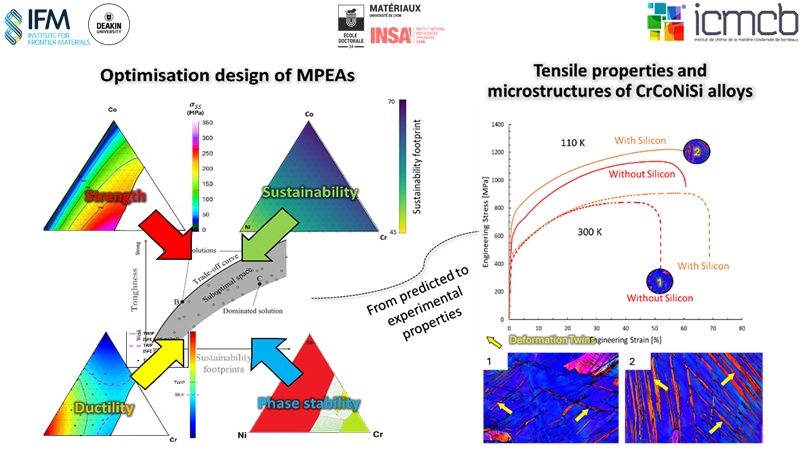
Toughness in High Entropy Alloys
TRIP/TWIP Ti alloys, RIP effect in Ti alloys
Thermodynamic and computational predictions
-
PhD Thesis
-
2021-2024 “Sustainability footprints and mechanical performance of multi-principal element alloys”
-
Teaching
-
Publications
-
2025 “Sustainability indicators in high entropy alloy design: an economic, environmental, and societal database” S. Gorsse, T. Langlois, A-C. Yeh, M. Barnett, Scientific Data.
Abstract: This work introduces a comprehensive dataset and framework for assessing the sustainability of high entropy alloys (HEAs) and other metallic alloys. The dataset includes nine crafted indicators—raw material price, supply risk, normalized vulnerability to supply restriction, embodied energy, water usage, rock-to-metal ratio, human health damage, human rights pressure, and labor rights pressure— for 18 elements: Al, Co, Cr, Cu, Fe, Hf, Mn, Mo, Nb, Ni, Re, Ru, Si, Ta, Ti, V, W, and Zr. This methodology evaluates economic viability, environmental impact, and societal implications using alloy compositions as input. The Python package, AlloySustainability, streamlines indicator computation and enables users to benchmark alloys against a database encompassing 340 HEAs and over 240 conventional steels and Ni-based superalloys. By integrating these tools with principles of responsible and informed design, this work promotes transparency and fosters innovative alloy development. The dataset and tools, freely available on GitHub, empower the scientific community to advance sustainable practices in metallurgy.
Link: https://doi.org/10.1038/s41597-025-04568-x
2024 “Considering sustainability when searching for new high entropy alloys” S. Gorsse, T. Langlois, M. Barnett, Sustainable Materials and Technologies 40.
Abstract: Alloying elements bring with them a level of undesirable societal impact. The present paper examines this impact, in terms of primary production, for 340 newly proposed high entropy compositions. Three areas of sustainability are considered: economic viability, environmental impact and human well-being. The high entropy alloys are considered in two classes: body centred cubic and related alloys with potential for high temperature application and face centred cubic and related Cantor-type alloys. The former are compared to Ni-based superalloys and the latter to advanced steels. It is seen that with improved performance of Ni-based superalloys there has been an increase in undesirable impact across many of the indicators we employ. However, some recently proposed high temperature high entropy alloys – especially Yeh-type High Entropy Superalloys - display notably lower levels of undesirable impact than Ni-based superalloy compositions. Cantor-type face centred cubic alloys, however, do not compare so favourably when stacked up against the best steels, for room temperature strength and ductility. We show that, in general, there is good scope for high entropy alloys to be designed that target lower levels of undesirable impact.