Post-doc Researcher
Campus du Solbosch - CP 165/63
Avenue F.D. Roosevelt, 50
1050 Bruxelles
-
Biosketch
-
Claire Fourmentin obtained her engineering degree from the École Nationale Supérieure de Chimie de Rennes, along with a double master’s degree in Solid-State and Materials Chemistry from the University of Rennes. She completed her PhD at the University of Rennes within a DGA-funded project in collaboration with Umicore IR Glass, focusing on the development of Gradient Refractive Index (GRIN) optics by ion exchange for thermal imaging applications in the 8–12 µm range.
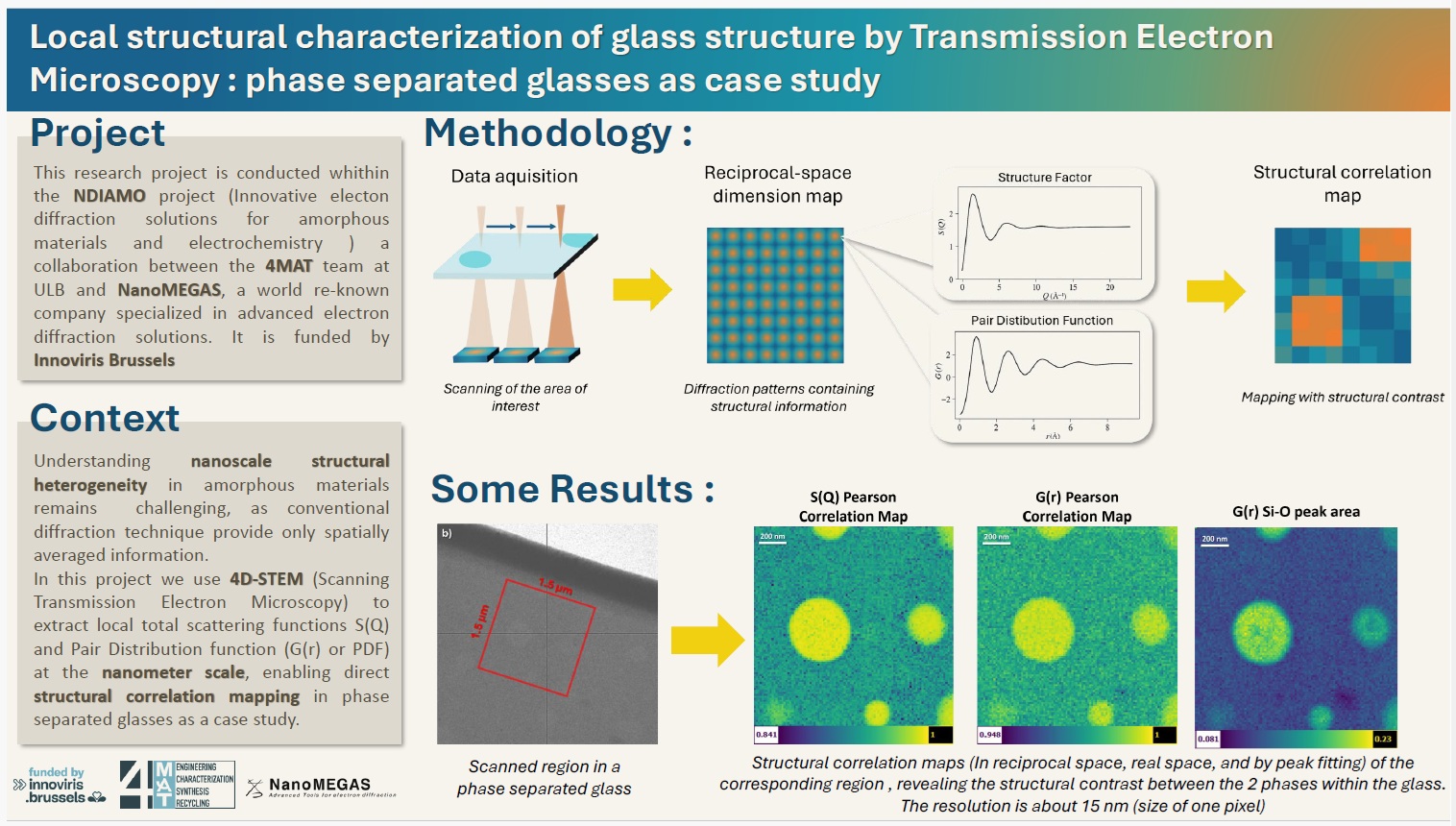
She is currently a postdoctoral researcher at the Université libre de Bruxelles (ULB), where her work centers on the local structural characterization of glass by Transmission Electron Microscopy, with particular emphasis on opalescent and phase-separated glasses. This research is conducted within the NDIAMO project (“Innovative electron diffraction solutions for amorphous materials and electrochemistry”), a collaboration between Nanomegas, , a world re-known company specialized in advanced electron diffraction solutions, and 4MAT at ULB funded by Innoviris Brussels.
Since 2024, she has also been serving as a lecturer at Polytech Bruxelles.
-
Research Topics
-
Local structural characterization of glass structure by Transmission Electron Microscopy : phase separated glasses as case study
Her research project is conducted within the framework of the NDIAMO project (“Innovative Electron Diffraction Solutions for Amorphous Materials and Electrochemistry”), a collaboration between the 4MAT team at the Université libre de Bruxelles (ULB) and NanoMEGAS, a world re-known company specialized in advanced electron diffraction solutions, funded by Innoviris Brussels. The project aims to develop advanced electron diffraction approaches for the structural characterization of complex amorphous materials.
Understanding nanoscale structural heterogeneity in amorphous systems remains challenging, as conventional diffraction techniques provide only spatially averaged information. In this project, we use 4D-STEM (Scanning Transmission Electron Microscopy) to extract local total scattering functions S(Q) and Pair Distribution Functions G(r) (PDF) with nanometer-scale resolution. Using phase-separated glasses as model systems, this approach enables direct mapping of structural correlations and provides new insights into local structure–property relationships in glasses and more generally in amorphous materials.
FrART : Interfaces, Interphases
Claire is also involved in an art-science research project which aims to explore new connections between opalescent glass and ceramics. Supported by the FrART Fund for art research, this collaboration brings together the creative expertise of designer-ceramists from Studio Biskt and the interdisciplinary art-science platform Ohme, which fosters transdisciplinary collaborations between artists, scientists, and researchers. The project investigates how opalescent glass can be integrated into ceramic pieces, testing various techniques such as enamelling or thermoforming to push the boundaries of form, texture, and material interaction
-
PhD Thesis
-
Teaching
-
CHIM-H316: Matériaux et Chimie Inorganique : Mise en forme et Analyse
CHIM-H415: Ceramics
-
Publications
-
Fourmentin, C., Guichard, J., Druart, G., et al. Infrared Gradient Refractive INdex (GRIN) Materials Through Fast Solid-Solid Na+/Ag+ Ionic Exchange in Chalco-Halide Glasses. Adv. Funct. Mater. 2024, 2312275. https://doi.org/10.1002/adfm.202312275
Fourmentin, C., Célarié F., Gueguen, Y. et al. Super cold crystallization of sodium iodine in selenium based chalco-halide glasses. Journal of Non-Crystalline Solids 617, 122503 (2023). https://doi.org/10.1016/j.jnoncrysol.2023.122503
Fourmentin, C., Zhang, XH., Lavanant, E. et al. IR GRIN lenses prepared by ionic exchange in chalcohalide glasses. Sci Rep 11, 11081 (2021). https://doi.org/10.1038/s41598-021-90626-4